 English
 Best Magnetic Door Lock for Access Control Kenya 2026
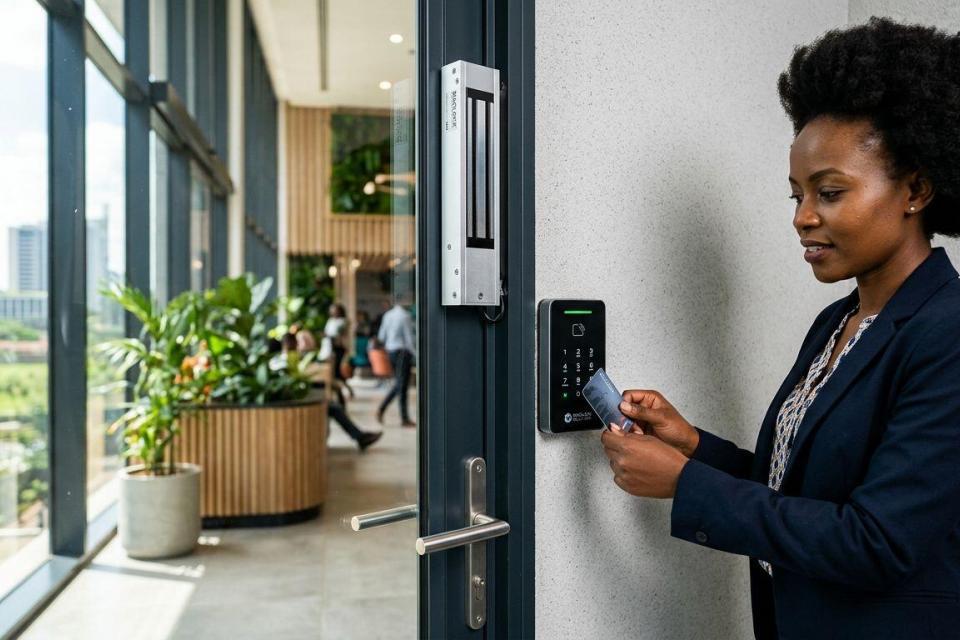
Magnetic door locks (maglocks) hold electrically and release on power cut, which is why they pair with access control readers, alarms and fire systems in Kenyan homes, offices and apartment blocks. The best magnetic door lock for access control in Kenya 2026 depends on door type and traffic: a standard 280kg (600lb) single-door maglock covers most home and office doors, a 545kg (1200lb) heavy-duty unit suits busy commercial entrances, and a fail-safe unit with exit override is mandatory on fire-rated exits.
- Standard 280kg (600lb) maglocks are the best magnetic door lock for access control on timber, glass and aluminium office doors.
- 545kg (1200lb) heavy-duty maglocks suit main entrances with heavy daily traffic and metal doors.
- Double-door maglocks and fail-safe exit override units are non-negotiable on fire exits and emergency routes.
- Compact maglocks under 180mm fit cabinets, server racks and narrow aluminium frames where a full-size unit won’t mount.
- Pairing any maglock with a reader from a 2026 access control kit matters more than the lock brand alone.
Why this matters
A maglock that's undersized for the door leaf will get forced or will fail intermittently under vibration from wind or slamming. An oversized unit on a light aluminium frame just wastes money and current draw. Getting the holding force and fail mode right the first time avoids a second site visit and a second install charge in 2026.
Maglocks also fail differently to electric strikes: they're fail-safe by design, meaning they unlock on power loss. That's exactly what fire code wants on an emergency exit, but it means you need a backup battery or UPS if you want the door secured during a blackout. This is the single most common mistake on access control systems for small businesses installs in Nairobi: the lock is right, the power backup isn't planned.
What makes the best magnetic door lock for access control
- Holding force matched to door mass and traffic — 280kg for standard doors, 545kg for heavy or high-traffic doors
- Fail-safe operation confirmed — the door must unlock on power failure for fire code compliance
- Bracket compatibility with the door frame — L-brackets, Z-brackets or U-brackets depending on frame depth
- Door position sensor (magnetic reed) built in or added separately, so the controller knows when the door is actually shut
- Compatibility with the reader and controller already installed or planned, whether biometric, card or PIN
- Backup power provision so the lock stays secured through short outages without breaching fire-exit rules
Magnetic door locks at a glance
| Type | Best for | Standout feature | Key limitation |
|---|---|---|---|
| Standard single-door maglock (280kg) | Home and office doors | Fits most timber, glass and aluminium doors | Undersized for heavy steel or double doors |
| Heavy-duty maglock (545kg) | Busy commercial entrances | Handles daily high-traffic slamming and forcing | Higher current draw, needs a stronger power supply |
| Double-door maglock | Double-leaf entrances and fire exits | Two independent lock bodies, one bracket set | Needs careful alignment on both leaves |
| Compact/mini maglock | Cabinets, racks, narrow frames | Low-profile body under 180mm | Lower holding force, not for main entrances |
| Fail-safe maglock with exit override | Fire-code emergency exits | Releases instantly on fire alarm trigger | Must be wired into the fire alarm circuit correctly |
1. Standard single-door maglock (280kg): best for home and office doors
This is the workhorse of access control in Kenya: a 280kg (600lb) holding force unit mounted on the door head, paired with an armature plate on the door leaf. It suits timber, glass and standard aluminium doors in homes, offices and small retail units.
Standard maglock pros:
- Fits the majority of residential and office door frames without modification
- Lower current draw than heavy-duty units, easier on a small UPS
- Works with any reader type — biometric, RFID card, or keypad
Standard maglock cons:
- Not rated for heavy steel doors or doors with strong wind exposure
- Needs a door closer fitted correctly or the magnetic faces won't align
Best for: homes, small offices, retail entrances. Verdict: Buy for standard single-leaf doors.
2. Heavy-duty maglock (545kg): best for busy commercial entrances
At 545kg (1200lb) holding force, this unit is built for entrances with constant foot traffic — office blocks, apartment lobbies, and commercial buildings where the door gets slammed dozens of times a day. It draws more current than the standard unit, so the power supply needs sizing accordingly.
Heavy-duty maglock pros:
- Holds firm under repeated slamming and forced-entry attempts
- Suits metal and reinforced doors that flex the 280kg unit over time
- Pairs well with apartment building access control kits where multiple residents cycle through daily
Heavy-duty maglock cons:
- Higher current draw means a bigger power supply or backup battery
- Overkill and wasteful on a light interior door
Best for: office blocks, apartment main gates, commercial entrances. Verdict: Buy where daily traffic is high.
3. Double-door maglock: best for double-leaf entrances and fire exits
Double-leaf doors need two independent magnetic bodies, usually mounted on a shared bracket set, so each leaf locks and releases on its own. This is standard on boardroom doors, main building entrances with double doors, and designated fire exits.
Double-door maglock pros:
- Each leaf locks independently, so one leaf can be serviced without disabling both
- Matches double-leaf fire exit requirements when wired fail-safe
Double-door maglock cons:
- Alignment on both leaves takes more care during install
- Costs more in labour than a single unit due to two brackets and two runs of cable
Best for: boardrooms, double-leaf lobbies, fire exits. Verdict: Buy where the door is genuinely double-leaf.
4. Compact/mini maglock: best for cabinets, racks and narrow frames
Under 180mm in body length, the compact maglock secures server cabinets, comms racks, and narrow aluminium-framed doors where a full-size 280kg unit physically won't mount. Holding force is lower, so it's not a substitute for a main entrance lock.
Compact maglock pros:
- Fits narrow frames and cabinet doors a standard maglock can't
- Lower power draw, suited to cabinets already running on a small backup supply
Compact maglock cons:
- Holding force too low for a primary building entrance
- Limited bracket options compared to standard-size units
Best for: server racks, comms cabinets, storage units. Verdict: Buy for equipment enclosures, Skip for main doors.
5. Fail-safe maglock with exit override: best for fire-code emergency exits
Every maglock is fail-safe by design, but this configuration adds a dedicated exit override wired directly into the fire alarm panel, so the door releases instantly the moment the alarm triggers — independent of the access control reader.
Fail-safe exit override pros:
- Meets fire-code requirements for emergency egress without depending on the reader working
- Cuts response time to zero on alarm trigger
Fail-safe exit override cons:
- Needs correct wiring into the fire alarm control panel, not a plug-and-play job
- Requires periodic testing alongside the fire alarm control panel itself
Best for: fire exits, escape routes, buildings under fire-code inspection. Verdict: Buy, non-negotiable on designated exits.
How we ranked
Each type is ranked against the six criteria above: holding force fit, fail-safe compliance, bracket compatibility, door position sensing, reader compatibility, and backup power provision. No single type wins across every door in a building — the ranking is a decision tree by door type and traffic, not a single winner.
Get the right maglock for your doors
Match holding force and fail-safe wiring to each door before you buy.
Which magnetic door lock should you choose?
For a single office or home door, the 280kg standard maglock is the best magnetic door lock for access control in most Kenyan installs in 2026. Step up to a 545kg heavy-duty unit on any entrance with constant traffic, and never skip the fail-safe exit override on a designated fire exit — that one is a compliance requirement, not a preference. Pair the lock with a reader that matches how people already move through the building; a fingerprint door lock for offices works well where staff turnover is low, while an RFID access card system suits buildings with visitor traffic.
FAQ
What is the best magnetic door lock for access control in Kenya?
A 280kg (600lb) standard maglock is the best magnetic door lock for access control on home and office doors in Kenya. Busy commercial entrances need a 545kg (1200lb) heavy-duty unit instead.
Is a magnetic lock better than an electric strike?
A magnetic lock holds with continuous current and releases instantly on power loss, which suits fire-code exits better than an electric strike. Electric strikes suit doors where mechanical key override is required alongside access control.
Do magnetic door locks work during a power cut?
No, standard maglocks are fail-safe and unlock the moment power is cut, which is required for fire exits. A backup battery or UPS is needed if the door must stay secured during short outages.
What holding force does a magnetic lock need for a main entrance?
Main entrances with daily heavy traffic need a 545kg (1200lb) maglock rather than the standard 280kg unit. Lighter interior office doors are adequately secured with the 280kg option.
Can a magnetic lock be used on a double door?
Yes, a double-door maglock uses two independent lock bodies, one per leaf, mounted on a matched bracket set. This is standard on boardrooms and double-leaf fire exits.
Does a magnetic door lock need a door position sensor?
Yes, a magnetic reed sensor confirms to the controller whether the door is actually shut, which most maglocks include or allow as an add-on. Without it, the access control system can’t reliably log door status.
Are magnetic locks legal on fire exits in Kenya?
Fail-safe maglocks with an exit override wired into the fire alarm panel are used specifically to meet fire-code emergency egress requirements. The override must release the door the instant the fire alarm triggers, independent of the access control reader.
What size maglock fits a server cabinet or rack?
A compact or mini maglock under 180mm in body length fits cabinet doors and narrow aluminium frames where a full-size 280kg unit won’t mount. Holding force is lower, so it’s not suited to a main building entrance.
One last thing
The detail installers miss most often in 2026 isn't the lock — it's the backup power sizing. A 545kg maglock under continuous load draws noticeably more current than a 280kg unit, and undersizing the backup battery means the door drops open during a longer outage even when that wasn't the plan.
Related guides