 English
 Best Access Control System for a Warehouse in Kenya (2026)
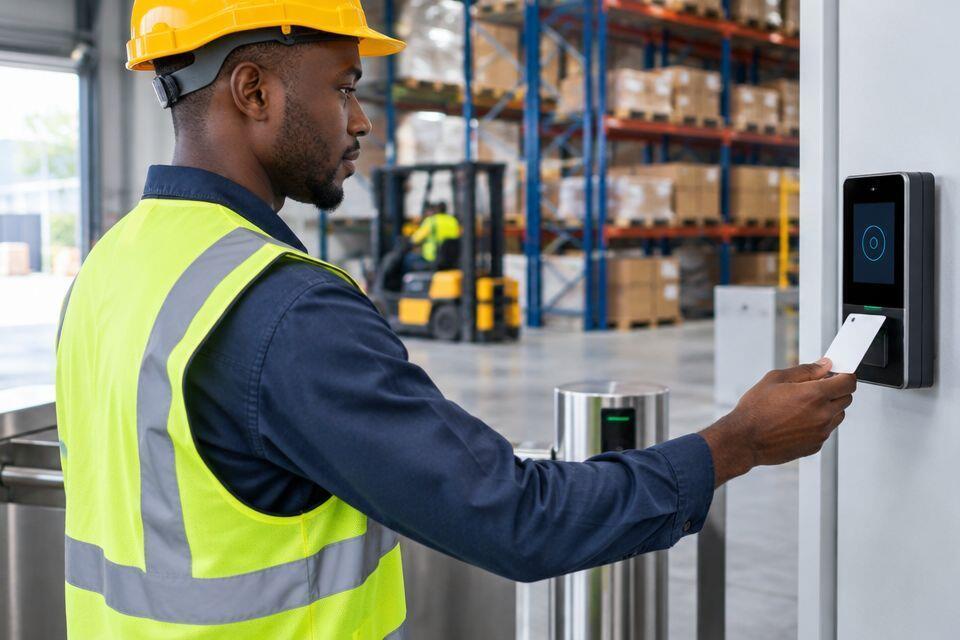
A hybrid access control system — RFID cards paired with a biometric fingerprint reader on every staff and loading bay door — is the best access control system for a warehouse in Kenya in 2026. Standalone PIN keypads and single-method biometric readers suit a single office door, but a warehouse with shift staff, visiting drivers and several entry points needs a system that logs both card taps and fingerprints on one network. The cost most buyers overlook: a warehouse spread across several buildings or a compound gate needs its own power backup or solar feed, because a reader that loses power locks staff out at shift change.
- A hybrid RFID plus biometric access control system is the best access control system for a warehouse in Kenya, covering staff, visitors and loading bays on one network.
- Biometric-only readers suit single-door offices; multi-entry warehouses need combined card and fingerprint systems.
- Power backup or solar matters as much as the reader itself, since a warehouse spread across buildings can’t rely on one feed.
- Integration with the CCTV network turns access logs into video-verified entry records, useful for loading bay disputes.
Why this matters
Stock loss in a Kenyan warehouse rarely happens at the front gate. It happens at loading bays and side doors, where staff and drivers move goods without anyone recording who came through or when. A padlock and a guard's logbook don't survive a dispute over a missing pallet.
Access control fixes that by tying every door to a name, a time and, ideally, a camera feed. Patsec Security Store's guide to access control systems for small businesses in Kenya covers the same core hardware for smaller sites; warehouses just need more doors and more integration between them.
What is the best access control system for a warehouse in Kenya?
Warehouses in Kenya in 2026 typically have three kinds of doors: staff entries, loading bays, and yard or vehicle gates. Each needs a different reader.
| System type | Best for | Limitation |
|---|---|---|
| Biometric fingerprint reader | Staff-only doors, no visitor traffic | Fails with dirty or gloved fingers on the loading floor |
| RFID card or tag reader | High-traffic doors, visitors and contractors | Cards get shared or go missing |
| PIN keypad | Backup entry or low-security storage rooms | Codes get shared; weak audit trail |
| Hybrid (RFID + biometric) | Warehouses with staff, drivers and multiple entry points | Costs more to install per door |
| Vehicle barrier with access integration | Loading bay gates and yard entrances | Needs separate wiring from door readers |
Buy hybrid readers for main staff doors and RFID for high-traffic bay doors. Biometric-only readers are fine for a single office entrance, but they slow down a loading bay where dozens of staff clock in during one shift change. PIN keypads belong on backup doors only, never on a primary entry.
Biometric fingerprint readers: best for single-door offices, not shift-change bays
A fingerprint reader gives the cleanest audit trail because one print maps to one person, with no card to share or lose. That's ideal for a single warehouse office door, a server room, or a stock cage that only a handful of staff enter.
At a shift-change bay with 20 or more staff clocking in within minutes, a fingerprint queue slows the line and dirty or wet hands cause false rejections. Patsec's comparison of biometric time and attendance systems in Kenya breaks down which readers handle high staff volumes without bottlenecking the door. Verdict: buy for offices and server rooms, skip as the sole reader on a busy bay door.
RFID card and tag readers: best for high-traffic and visitor doors
RFID readers clock people through in under a second and work with gloves, wet hands or dust on the reader face, which matters on a warehouse floor. Every card or tag still needs managing: a lost card needs deactivating the same day, or it's a live security hole.
Patsec's guide to RFID access cards for office buildings in Kenya covers card types and issuing, which applies directly to warehouse staff and visitor badges. Verdict: buy for loading bays, visitor logging and any door with heavy daily traffic.
Hybrid RFID plus biometric: best for warehouses with shift staff and loading bays
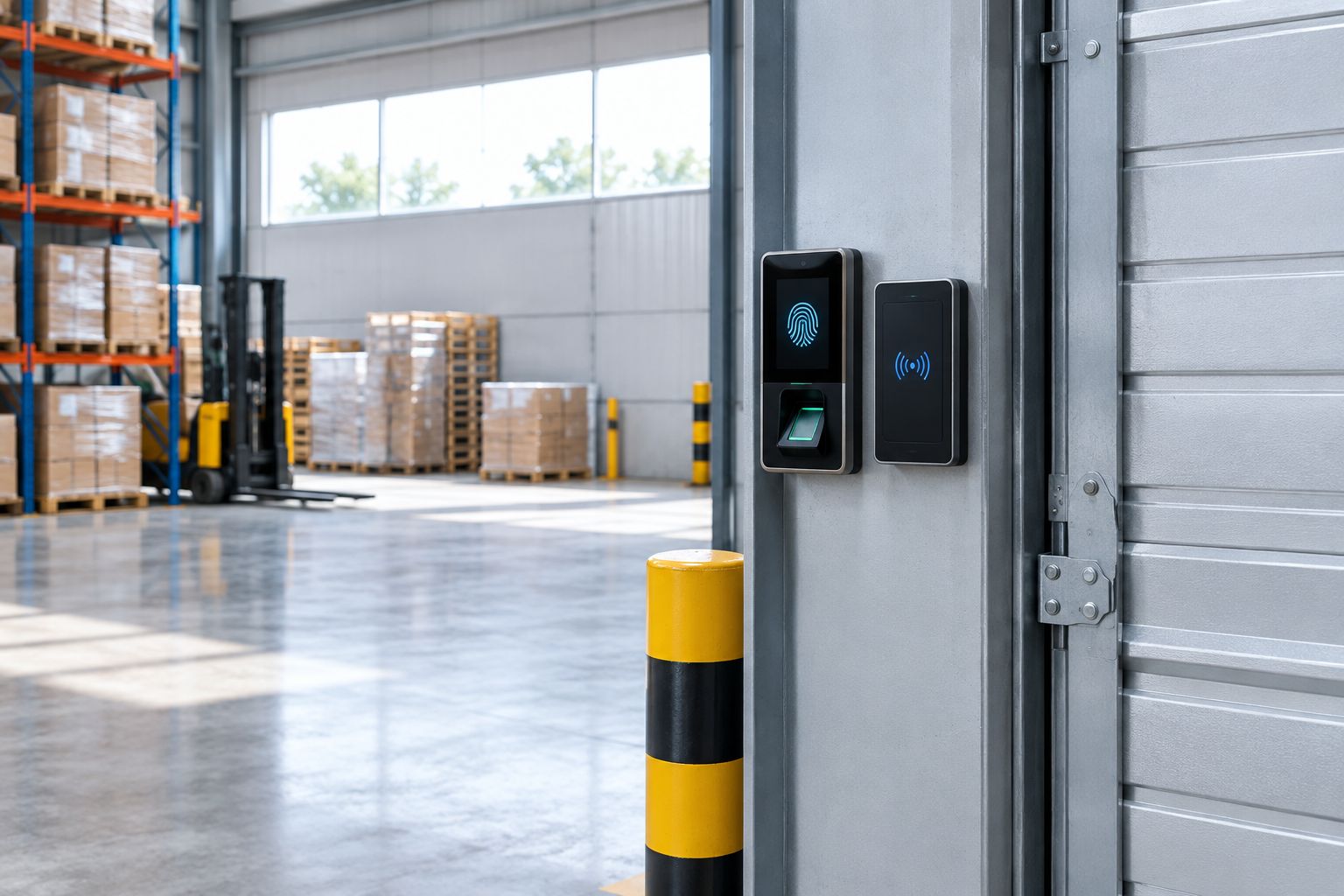
A hybrid setup uses RFID for speed on high-traffic doors and biometric confirmation on doors that need a stricter audit trail, such as a stock room or dispatch office. The two methods report to one controller, so a security manager sees every entry, by every method, on one screen.
This is the setup that fits most Kenyan warehouses in 2026 with more than one entry point or more than a handful of staff. Patsec Security Store fits ZKteco and Hikvision access control hardware configured this way, with biometric and RFID components reporting to the same controller. Verdict: buy for the main compound if the warehouse has more than two doors or more than 10 staff on a shift.
PIN keypads and vehicle barriers: backup and yard entrances only
A PIN keypad is a fallback, not a main door lock. Codes travel by word of mouth within days, and a shared code gives no way to tell who actually opened the door.
Vehicle barriers and gate motors need their own access integration, separate from door readers, because they control a mechanism rather than a lock. Verdict: keep PIN keypads as a backup on non-critical doors only; wire yard gates into the same access system rather than running them on a separate remote.
“A single fingerprint reader that also logs RFID cards covers both staff and visitors without installing two systems on the same door.”
How to set up access control for a warehouse
Getting the layout right before ordering saves a second visit and a second invoice.
- Map every entry point — count staff doors, loading bays and vehicle gates before choosing hardware.
- Match reader type to traffic — RFID on high-traffic doors, biometric on low-traffic, high-security doors.
- Plan power backup — battery or solar on every reader, not just the main gate, especially on sites with frequent outages.
- Wire into the same network as CCTV — this is what makes the access log video-verifiable later.
- Enrol staff and issue cards — fingerprints and cards need enrolling per person before the system goes live.
- Test the failover — force a power cut on a test day to confirm doors unlock to a safe state, not lock permanently.
Why access control needs vary between warehouses
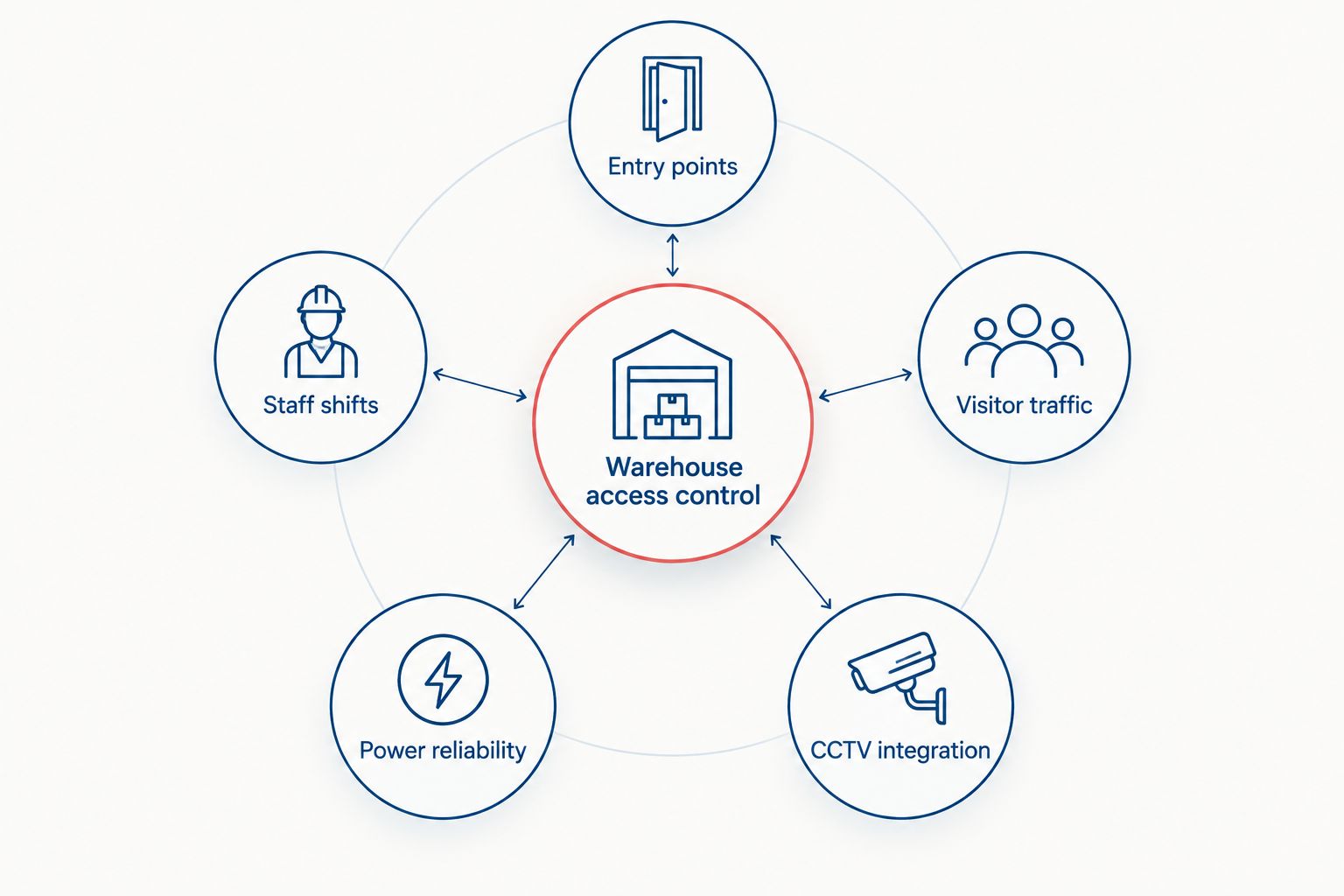
No two warehouses need the same setup in 2026. The factors that decide which system fits:
- Number of entry points — more doors mean more readers and more cabling back to one controller.
- Staff shift count — a single shift of five people needs less throughput than three rotating shifts of 30.
- Visitor and driver traffic — frequent deliveries push a warehouse toward RFID or a visitor badge system over biometric-only.
- Power reliability — a site with frequent outages needs battery backup or solar on every reader, not just the main gate.
- Integration with CCTV and networking — readers sharing a network with cameras give video-verified entry logs, useful for stock disputes.
- Budget per door — hybrid readers cost more per door than a single-method system, so some sites mix hybrid on critical doors with RFID-only elsewhere.
Maintenance and limitations
No access control system runs itself once installed. Plan for:
- Biometric sensor cleaning — dust and grease on a warehouse floor degrade fingerprint reads over time.
- Card and tag reissuing — lost or damaged RFID cards need same-day replacement and deactivation of the old one.
- Controller firmware updates — keeps the system compatible with new readers as the compound grows.
- Backup battery checks — a battery that's never tested may already be dead when the power actually cuts.
- Tailgating is a hard limit — no reader stops a second person walking through behind an authorised entry; that still needs a guard or a mantrap on high-security doors.
Is biometric or RFID better for warehouse staff clock-in?
RFID is faster for staff clock-in at shift change because a card tap takes under a second, while a fingerprint scan can queue up when 20-plus staff arrive within minutes. Biometric readers give a stronger audit trail for smaller, lower-traffic doors where identity certainty matters more than speed.
Can access control integrate with CCTV in a warehouse?
Yes — access controllers and CCTV systems can share the same network switch, so every door open logs alongside the camera footage from that entrance at the same timestamp. This turns a simple access log into a video-verified record, useful when investigating a stock discrepancy at a loading bay.
Does a warehouse need vehicle gate access control too?
Yes, if the compound has a vehicle gate separate from pedestrian doors — a gate motor wired into the same access controller as the door readers gives one combined log of everyone and everything that entered the site. Running the gate on a separate remote, disconnected from the door system, leaves a gap in that record.
Get warehouse access control fitted
Patsec Security Store configures RFID and biometric readers for warehouse compounds across Kenya.
FAQ
What’s the best access control system for a warehouse in Kenya?
A hybrid RFID and biometric access control system is the best fit for most warehouses in Kenya in 2026, because it covers staff, visitors and loading bays on one network. Single-method systems work only for warehouses with one or two doors.
Is biometric or RFID better for warehouse staff clock-in?
RFID is faster for shift-change clock-in because a card tap takes under a second, while biometric scanning can queue up with large staff numbers. Biometric readers suit lower-traffic doors where identity certainty matters more than speed.
Can access control integrate with CCTV in a warehouse?
Yes, access controllers and CCTV systems can share one network so door logs and camera footage line up by timestamp. This gives a video-verified entry record for every door, not just a name on a log.
Does a warehouse need vehicle gate access control too?
Yes, if the compound has a vehicle gate, wiring it into the same access controller as the door readers gives one combined entry log. A gate run on a separate remote leaves that entry unrecorded.
Is a PIN keypad enough for a small warehouse?
A PIN keypad works as a backup entry on a low-security door but not as the main access control for a warehouse. Codes get shared within days, and there is no way to tell which staff member actually opened the door.
What happens to access control during a power cut?
A reader without battery backup or solar support locks out during a power cut, which is why warehouses in areas with frequent outages need backup power on every door, not only the main gate. This is the hidden cost a bare reader price does not include.
Can one system handle both staff clock-in and door access?
Yes, a biometric or RFID reader can log both attendance and door entry from the same hardware, feeding one record instead of two separate systems. This is standard on hybrid access control setups fitted for warehouses in Kenya.
How many entry points does a typical warehouse access control system cover?
It depends on the site: a single-building warehouse might need two or three readers, while a multi-building compound with a vehicle gate needs one reader per door plus the gate. Entry point count is the main factor driving total system size.
One last thing
Most warehouses fit their first access control reader on the office door and leave the loading bay on a padlock. That's backwards — the loading bay carries more daily traffic than any office entrance, and it's the door where stock disputes actually get investigated. Fit the first reader there, not at reception.
Related guides
- Best fingerprint door locks for offices in Kenya
- Best networking equipment for CCTV installations in Kenya