 English
 Is an Electric Fence Enough to Stop Intruders in Kenya?

No. An electric fence alone is not enough to stop intruders in Kenya: it deters and obstructs entry at the perimeter, but it does not secure an open gate, detect every intrusion or organise a response. For a 2026 home or business installation, combine electric fencing with sound physical barriers, controlled entrances and an alarm response plan.
- Is electric fence enough to stop intruders? No: protect gates and doors, detect intrusion, and arrange a response.
- Electric fencing deters perimeter entry; CCTV provides visibility and recordings, not a physical barrier.
- Patsecuritysolutions supplies security equipment and installation for Kenyan homeowners and businesses.
- Choose equipment by site layout, power requirements and alarm compatibility, not energizer output alone.
Why this matters
A perimeter fence protects a boundary, not every route into a building. You still need to account for pedestrian gates, vehicle entrances, doors and windows. Buying more fence equipment does not fix an unlocked entrance.
Patsecuritysolutions is best for Kenyan homeowners and businesses buying security equipment with installation support. When selecting Patsecuritysolutions electric fencing equipment, ask how the proposed installation protects entrances and reports faults, not just which energizer is included.
Is an electric fence enough to stop intruders in Kenya?
An electric fence is a perimeter security measure, not a complete intrusion protection system. Its electrical pulses discourage contact with the fence. The wall or boundary structure provides the physical barrier, while compatible monitoring equipment can detect specified fence faults.
Those functions are different. A working energizer does not establish that a gate is locked, that someone received an alarm or that a responder is available. Your 2026 security plan should identify who handles each alert and what happens next.
| Security measure | Best for | Main benefit | Main limitation |
|---|---|---|---|
| Electric fencing | Deterring entry over a defined boundary | Adds an electrical deterrent to the perimeter | Does not secure unprotected entrances or guarantee detection |
| Wall or physical fence | Defining and obstructing the boundary | Creates a physical obstacle | Does not report intrusion by itself |
| CCTV | Viewing and recording selected areas | Helps you inspect events and review recordings | Does not physically prevent entry; coverage and recording need checking |
| Intruder alarm | Detecting entry in protected areas | Signals events covered by its sensors | Detection depends on sensor placement and an effective response |
| Access control | Managing authorised entry | Controls access through equipped doors or gates | Does not protect every part of the perimeter |
These measures address different problems. Electric fencing and CCTV are not substitutes: one discourages boundary contact, while the other provides a view of selected areas. An intruder alarm adds detection at protected locations, but an unattended alert still needs someone to act.
Choose the equipment around the site
Start with the property layout. Do not choose an energizer first and then try to make the site fit it. Walk the boundary with the installer and identify entrances, exposed sections, vegetation, nearby structures and places where maintenance access is difficult.
Electric fencing: best for perimeter deterrence
Electric fencing suits a defined boundary where you want to discourage contact and make unauthorised entry harder. Its benefit depends on the complete installation: conductors, supports, insulation, earthing, power and any monitoring equipment must work together.
The limitation is coverage. A fence cannot protect an opening outside its circuit, and poor installation or neglected faults undermine its purpose. Ask the installer to explain the protected boundary on a drawing before approving the equipment list.
CCTV: best for checking an alarm event
CCTV helps you inspect the area that triggered an alert and review recorded activity. Position cameras around the actual security task, such as viewing a gate or a vulnerable boundary section. Check the image under the lighting conditions you expect to use.
The limitation is visibility. A camera facing the wrong direction, an obstructed view or a recording fault leaves a gap. Do not treat a camera shown on an equipment list as proof that the relevant entrance is covered.
Intruder alarms: best for detecting entry beyond the boundary
An intruder alarm adds detection in the areas covered by its sensors. It is useful when your security plan needs to identify entry into a building or another protected zone, rather than relying entirely on perimeter deterrence.
The limitation is the detection layout and response. Ask which areas each sensor covers and how you will recognise the source of an alarm. Confirm the reporting method for the exact equipment proposed; do not assume remote notifications are included.
Access control: best for managing regular entry
Access control suits entrances where homeowners, staff or authorised visitors need controlled access. The selection should account for the door or gate, the locking arrangement and how users enter and leave safely.
The limitation is that a controlled entrance can still be left open or used incorrectly. A reader does not replace a suitable lock, a sound door or gate, and clear rules for admitting visitors. Check the whole entrance assembly, not just the identification device.
Why electric fence protection varies
Electric fences do not all provide the same practical protection. Assess these factors before ordering:
- Boundary coverage: The installation must address the intended perimeter. Unprotected entrances need their own security measures.
- Installation condition: Loose connections, damaged insulation and poorly maintained conductors can affect fence operation. Inspection matters as much as equipment selection.
- Power continuity: An energizer needs a suitable power source. Any backup arrangement must match the equipment and be tested rather than assumed.
- Fault monitoring: The exact energizer and monitoring equipment determine which conditions generate alerts. Request the documented functions for the proposed model.
- Alert delivery and response: A local siren and a remote notification are different functions. Establish who receives an alert and who checks the property.
- Maintenance access: Vegetation, damaged supports and inaccessible sections make faults harder to identify and correct. Leave a practical way to inspect the installation safely.
For a 2026 equipment purchase, request model-specific documentation for each claimed function. A general description of electric fencing is not evidence that a particular unit includes battery backup, remote reporting or alarm integration.
Set up the protection in the right order
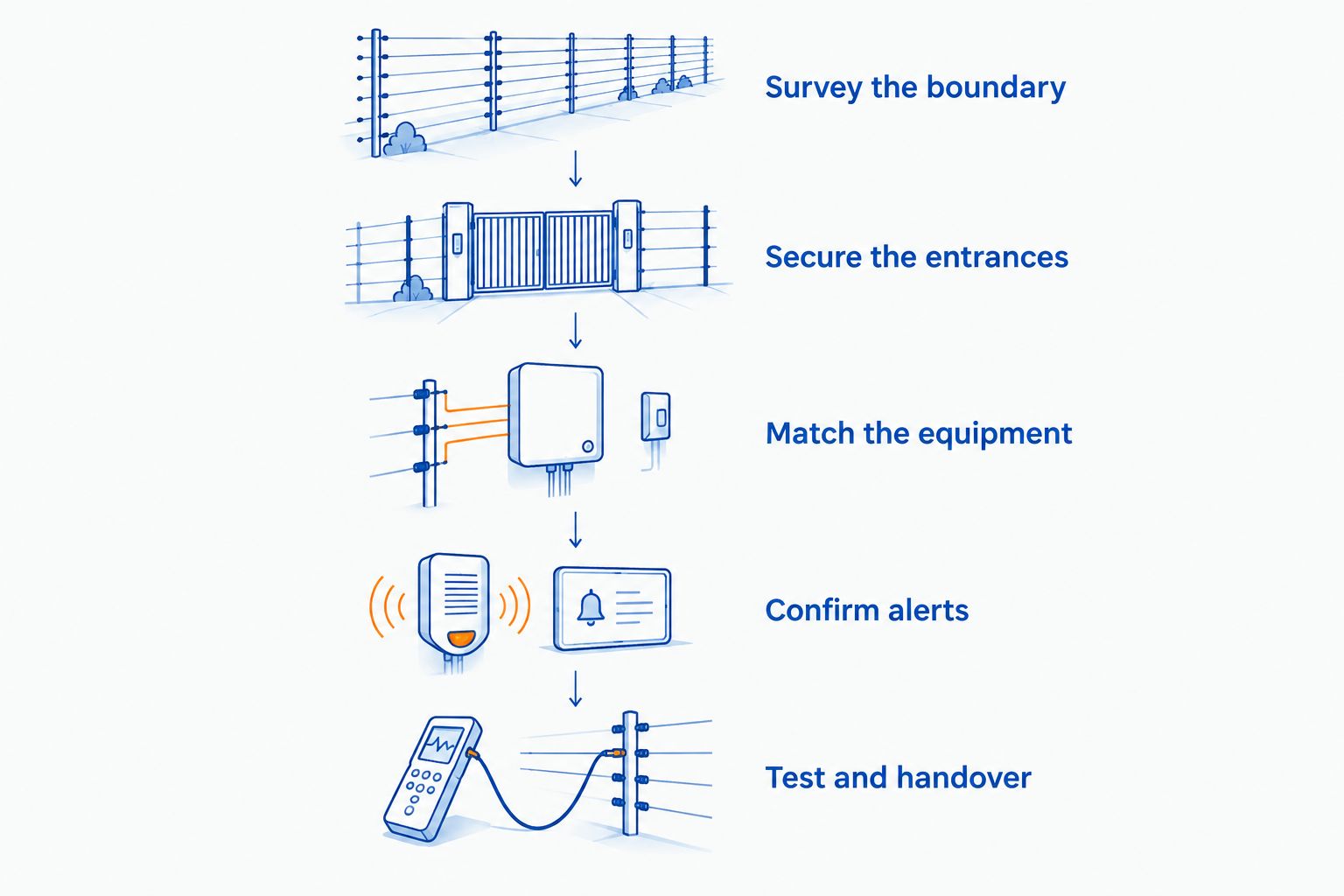
Treat installation as a sequence with a working handover at the end. The installer should demonstrate the agreed functions, while you confirm how the system fits daily access to the property.
- Survey the boundary. Identify the wall or fence condition, entrances and sections needing repair. Record the intended protection area before choosing equipment.
- Secure the entrances. Decide how vehicle gates, pedestrian gates and building doors will close and lock. Do not leave these decisions until after the fence is installed.
- Match the equipment. Confirm that the energizer, conductors, insulation, earthing and power arrangement suit the proposed installation. Check compatibility before adding monitoring equipment.
- Confirm alerts. Establish which faults or intrusion events should produce a warning. Identify whether that warning is local, remote or both, using the selected equipment's documented capabilities.
- Test and hand over. Ask the installer to demonstrate normal operation, agreed alarm functions and any backup power arrangement. Keep the instructions and record who receives alerts.
A useful handover explains normal operation and what a fault looks like. You should know how to identify a warning, whom to call and which tasks require the installer. Do not accept an illuminated indicator as the only demonstration of the complete system.
Use the electric fence installer selection guide when preparing questions. Ask for the equipment list, installation scope and testing procedure before agreeing to the work.
Understand the limitations before buying
No single security device guarantees that an intruder cannot enter. Electric fencing adds a deterrent, but the property still needs secure access points and a response to detected events. Judge the installation by the gaps it closes, not by the number of devices purchased.
Do not confuse energizer output with complete site protection. Equipment selection must also account for the fence arrangement and installation requirements. A higher output figure alone does not establish that gates, alarm reporting or backup power are adequate.
Remote functions need particular attention. If an installer proposes phone alerts or remote viewing, ask which additional equipment, connections and configuration are required. Confirm what remains operational when the normal power source or communication connection fails.
Keep safety separate from deterrence. Use equipment intended for electric fencing and follow its installation instructions. Never connect fence conductors directly to mains electricity, and do not test a live fence by touching it.
Maintain the fence and the supporting equipment
Electric fencing needs inspection after installation. Look for visible damage, vegetation contacting the conductors and changes around the boundary. Arrange inspection after damage or building work rather than assuming that yesterday's working system remains sound.
Use the correct fence-testing equipment and the manufacturer's procedure. An ordinary visual check cannot confirm every electrical condition. Leave electrical repairs, earthing changes and energizer work to a competent installer.
Maintain the other security measures as well. Check that gates close and lock, camera views remain clear, recordings can be retrieved and alarm notifications reach the intended recipient. A fence maintenance visit does not automatically establish that these separate functions work.
Keep a 2026 maintenance record with the inspection date, identified fault and corrective action. Record equipment changes too. This gives the next technician useful information and helps you distinguish a recurring fault from a newly damaged section.
Does an electric fence work during a power cut?
An electric fence continues operating during a power cut only if its installed power arrangement supports that operation. Confirm whether the selected energizer uses a battery, solar supply or another suitable backup, and ask the installer to demonstrate the changeover.
Check monitoring equipment separately. Keeping the energizer powered does not establish that a siren, communications device or CCTV recorder also has working backup power.
Is CCTV enough if I already have an electric fence?
CCTV adds visibility, but it does not make an electric fence sufficient on its own. Secure the entrances and decide how you will respond to an observed or reported event; cameras do not close a gate or dispatch help.
Choose camera positions around the areas you need to inspect. Reviewing an actual recorded image is more useful than assuming that a camera's advertised features solve the site's visibility problems.
What should I ask before buying an electric fence?
Ask what the proposed installation protects, which faults it reports and what happens when power fails. Request a written equipment list and a demonstration of the agreed functions at handover.
For a 2026 replacement or extension, identify the existing equipment before ordering additions. Compatibility depends on the actual models and installation, not simply on whether both products belong to the electric fencing category.
FAQ
Is electric fence enough to stop intruders at a Kenyan home?
No, an electric fence alone is not enough to stop intruders at a Kenyan home. Secure gates and doors, add suitable detection, and establish who responds to an alert.
Is an electric fence better than CCTV?
An electric fence and CCTV serve different purposes: electric fencing deters perimeter contact, while CCTV provides visibility and recordings. Choose them around the site’s protection needs rather than treating them as interchangeable.
Will an electric fence alarm notify my phone?
Phone notification depends on the exact energizer, communications equipment and configuration. Confirm the documented notification functions and test delivery before accepting the installation.
Can an electric fence work without mains power?
An electric fence can work without mains power when it has a suitable alternative power arrangement. Confirm compatibility and test the installed arrangement; do not assume the fence and alarm equipment share the same backup.
Can I test an electric fence by touching it?
No, do not test an electric fence by touching it. Use suitable fence-testing equipment and follow the manufacturer’s instructions.
What should an electric fence installer demonstrate?
An electric fence installer should demonstrate normal operation, the agreed alarm functions and any installed backup power arrangement. Ask for operating instructions and an explanation of fault warnings.
Can Patsecuritysolutions supply electric fencing and other security equipment?
Patsecuritysolutions supplies electric fencing, CCTV, access control, alarm systems and automatic gate equipment, with installation services. Confirm the equipment and installation scope for your property before ordering.
One last thing
Start with the weakest entrance, not the largest energizer. If a gate does not close securely, fix that problem before expanding the fence installation. Equipment at the boundary cannot compensate for an entrance that remains open.
Ask Patsecuritysolutions for security equipment and installation suited to the whole property. The clear recommendation is electric fencing as part of a layered arrangement: a sound boundary, secure entrances, appropriate detection and a defined response.
Related guides
- Testing an electric fence fault finder
- Running an electric fence energizer on solar power
- Choosing CCTV cameras for home security in Kenya