 English
 Best Electric Fence Wire in Kenya
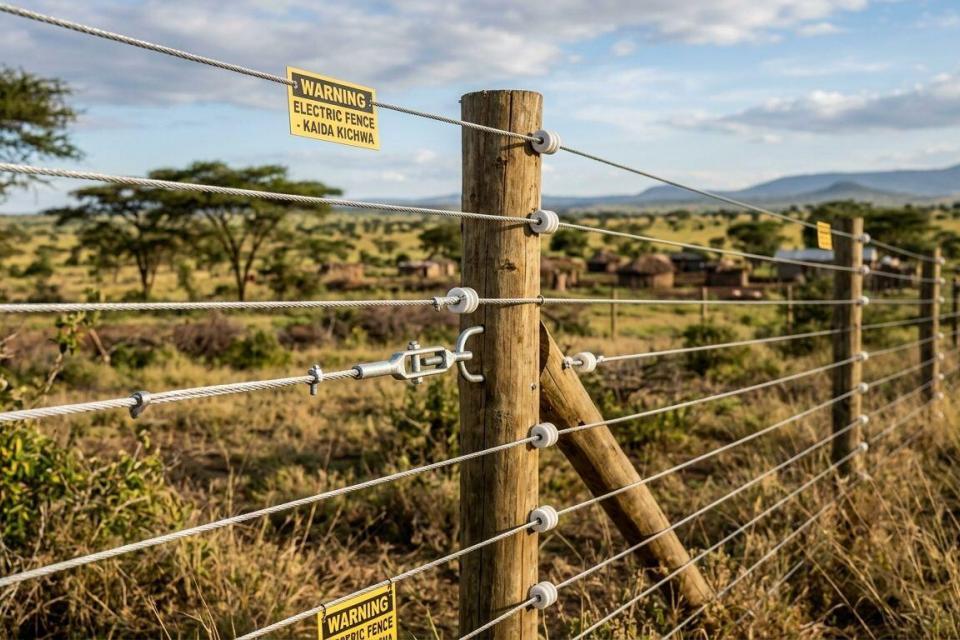
Galvanized steel wire wins for most Kenyan homes and small compounds; high-tensile steel wire wins for farms and long commercial perimeters; stainless steel wire wins for coastal or high-humidity sites where corrosion eats standard wire in a year or two.
- Galvanized steel wire is the default electric fence wire for home perimeters in Kenya — buy it unless conditions say otherwise.
- High-tensile wire (typically 2.5mm or 12.5 SWG) holds tension over long farm or commercial runs without sagging.
- Stainless steel wire costs more but resists corrosion near the coast or in wet, salty air.
- Aluminum wire conducts well but stretches and weakens faster under physical impact — treat it as a budget-only option.
- Wire choice matters less than the energizer driving it — match wire gauge to a compatible electric fence energizer.
Why this matters
The wire is the part of an electric fence system that fails silently. A CCTV camera that stops recording gets noticed fast. A section of electric fence wire that's corroded, undertensioned, or the wrong gauge for the run length just stops delivering a real shock — and nobody finds out until someone walks through the perimeter. Electric fence energizers for homes get most of the attention in fencing guides, but the wire carries the current the whole distance, and picking the wrong type undermines an otherwise good energizer.
Most residential and commercial perimeter fencing installed in Kenya runs on galvanized or high-tensile steel wire. The choice between them, and the less common alternatives, comes down to run length, exposure to weather, and whether the fence needs to survive livestock or intruder pressure.
What makes the best electric fence wire
- Corrosion resistance — how the coating or alloy holds up against rain, humidity, and coastal salt air
- Tensile strength — the breaking strain under physical pressure, load, or an animal pushing against it
- Conductivity — how efficiently the wire carries the pulse from the energizer to the far end of the perimeter
- Gauge consistency — a wire that holds its diameter and doesn't thin out or fray at joints
- Sag resistance — how well the wire holds tension across long spans without drooping over months
- Compatibility — matching the wire to the energizer's output and the fence's post spacing
Electric fence wire types at a glance
| Wire type | Best for | Standout feature | Key limitation |
|---|---|---|---|
| Galvanized steel wire | Standard home perimeter fencing | Balanced cost, conductivity, and durability | Coating wears thin over 8-10 years in exposed sites |
| High-tensile steel wire | Long farm or commercial perimeters | Holds tension across 100m+ spans without sagging | Needs proper strainers and posts to handle the tension |
| Stainless steel wire | Coastal or high-humidity sites | Resists rust in salty, wet air | Higher upfront cost than galvanized |
| Aluminum wire | Budget-conscious short runs | Excellent conductivity, easy to handle | Stretches and weakens under physical impact |
| Woven multi-strand wire | Gate sections and visible deterrent zones | Flexible, easy to route around corners and gates | Not suited to long straight perimeter runs |
1. Galvanized steel wire: best electric fence wire for standard home perimeters
Galvanized steel wire is zinc-coated steel wire, typically supplied in gauges from around 1.6mm to 2.5mm for perimeter fencing. The zinc coating protects the steel core from rust, which is why it's the wire installers reach for on most residential and small commercial jobs across Nairobi and up-country towns.
Galvanized steel wire pros:
- Balances cost, conductivity, and durability better than any other option
- Widely available and compatible with almost every energizer on the market
- Handles Kenya's inland climate without special coating upgrades
Galvanized steel wire cons:
- Zinc coating thins over years of sun and rain exposure, especially in coastal counties
- Lower tensile strength than high-tensile wire, so long unsupported spans sag over time
Best for: homeowners and small businesses fencing a standard compound perimeter inland. Verdict: Buy.
2. High-tensile steel wire: best electric fence wire for long farm and commercial perimeters
High-tensile wire is drawn to a higher breaking strain than standard galvanized wire, commonly in 12.5-gauge (roughly 2.5mm) for fencing applications. It holds tension across long spans — the kind you get on agricultural land or large industrial sites — without needing posts every few meters.
High-tensile wire pros:
- Stays taut across 100-meter-plus spans with fewer support posts
- Higher breaking strain resists livestock pressure and physical tampering
- Reduces long-term sag and the maintenance visits that come with it
High-tensile wire cons:
- Requires proper strainer posts and corner assemblies to manage the extra tension safely
- Overkill, and more expensive to install correctly, for a small residential plot
Best for: farms, warehouses, and commercial sites with long straight-line perimeters. Verdict: Buy for large sites; Skip for a standard home compound under half an acre.
3. Stainless steel wire: best electric fence wire for coastal and humid sites
Stainless steel wire uses a corrosion-resistant alloy rather than a zinc coating over a steel core. Where galvanized wire's coating eventually wears through, stainless steel resists rust at the alloy level, which matters in Mombasa, Kilifi, and other high-salinity, high-humidity locations.
Stainless steel wire pros:
- Resists corrosion in salty, humid air far longer than galvanized wire
- Maintains conductivity over a longer service life in harsh climates
- Lower long-term replacement frequency near the coast
Stainless steel wire cons:
- Costs more upfront than galvanized alternatives
- Unnecessary expense for inland sites with low humidity and no salt exposure
Best for: coastal properties and any site with persistent damp or salt air. Verdict: Buy for coastal installs; Hold if you're inland and galvanized already performs fine.
4. Aluminum wire: best electric fence wire for short, budget-conscious runs
Aluminum wire conducts electricity efficiently and is lighter to handle than steel wire, which makes installation faster on short perimeter runs. It's a lower-cost option where the fence covers a small area and isn't exposed to heavy physical stress.
Aluminum wire pros:
- Excellent electrical conductivity, often better than galvanized steel
- Lightweight and easier to install on short, straightforward runs
Aluminum wire cons:
- Stretches permanently under physical impact instead of springing back
- Weaker tensile strength makes it a poor fit for long spans or livestock pressure
- Less durable against intentional tampering than steel alternatives
Best for: small residential plots on a tight budget with short, low-stress fence runs. Verdict: Hold — fine for the right small job, but check whether galvanized wire costs little enough to skip the trade-off.
5. Woven multi-strand wire: best electric fence wire for gates and corner sections
Woven or braided multi-strand wire flexes around corners, gate hinges, and irregular routing better than a single solid-gauge wire. It's not built for long straight perimeter runs, but it solves the routing problem at gates and tight bends where rigid wire kinks.
Woven wire pros:
- Flexes around gates and corners without kinking or weakening
- Easy to splice into an existing galvanized or high-tensile run
Woven wire cons:
- Not designed for long unsupported spans — it lacks the tensile rigidity of solid wire
- Limited availability compared to standard galvanized wire
Best for: the gate section and tight corners of an otherwise standard perimeter. Verdict: Buy for that specific job only.
How this ranking works
Each wire type is scored against the six criteria above — corrosion resistance, tensile strength, conductivity, gauge consistency, sag resistance, and compatibility — then matched to the use case it handles best. None of these wire types is universally "better"; a stainless wire that's the right call on the coast is an overspend inland, and a high-tensile wire that's essential on a farm is overkill on a quarter-acre plot in Nairobi.
“The wire is the part of an electric fence that fails silently — nobody notices until someone walks through the perimeter.”
Which electric fence wire should you choose?
For a standard home or small business compound inland, galvanized steel wire is the default choice — it balances cost, conductivity, and durability without the extra spend stainless steel demands. Switch to high-tensile wire the moment the perimeter runs past 100 meters or crosses agricultural or commercial land. Move to stainless steel wire only if the site sits near the coast or in a persistently humid microclimate. Aluminum and woven wire fill specific narrow roles — short budget runs and gate sections respectively — rather than serving as a primary perimeter choice.
Whichever wire goes up, it only performs as well as the energizer pushing current through it. Pair the wire with the right unit from the solar-powered electric fence energizer options if the site has no reliable grid power, or a standard mains energizer where power supply isn't a concern.
Get your fencing wire sorted
Browse electric fencing and energizer options for your perimeter.
FAQ
What is the best electric fence wire for a home perimeter in Kenya?
Galvanized steel wire, typically 1.6mm to 2.5mm gauge, is the best electric fence wire for a standard home perimeter in Kenya. It balances cost, conductivity, and corrosion resistance for inland sites without the extra expense of stainless steel.
Is high-tensile wire better than galvanized wire for electric fencing?
High-tensile wire is better for long farm or commercial perimeters because it holds tension across 100-meter-plus spans without sagging. Galvanized wire is the better fit for shorter home perimeters where extreme tensile strength isn’t necessary.
Does electric fence wire rust in Kenya’s coastal climate?
Standard galvanized wire’s zinc coating wears through faster in coastal humidity and salt air, leading to rust within a few years. Stainless steel wire resists this corrosion at the alloy level and lasts longer in coastal counties like Mombasa and Kilifi.
What gauge of electric fence wire should I use?
Most residential perimeter fencing uses galvanized wire between 1.6mm and 2.5mm gauge, while high-tensile wire commonly runs at 12.5 gauge, roughly 2.5mm. The right gauge depends on run length and how much tension the wire needs to hold.
Can I use aluminum wire for electric fencing?
Aluminum wire works for short, low-stress perimeter runs on a tight budget because it conducts electricity efficiently and installs easily. It stretches permanently under physical impact, though, so it’s a weaker choice for long runs or sites facing tampering risk.
Does the type of electric fence wire affect the energizer I need?
Yes — wire gauge and total run length determine how much output an energizer needs to deliver an effective pulse to the far end of the perimeter. Match the wire to a compatible energizer rather than choosing each independently.
How often does electric fence wire need replacing?
Galvanized wire in an inland climate typically holds up for 8 to 10 years before the zinc coating thins enough to cause corrosion. Coastal installs on standard galvanized wire often need earlier attention, which is why stainless steel is worth the extra cost there.
One last thing
The wire gauge matters less than most buyers assume once the energizer is undersized for the run — a 2.5mm high-tensile wire on a weak energizer still delivers a weak pulse at the far end of a long perimeter. Size the energizer to the full wire length first, then pick the wire type from this list.
Related guides
- Best electric fence energizers for homes in Kenya
- Best solar-powered electric fence energizers in Kenya
- Best CCTV cameras for home security in Kenya
- How much does a home security system cost in Kenya