 English
 How Long Will an Electric Fence Battery Last in an Outage?
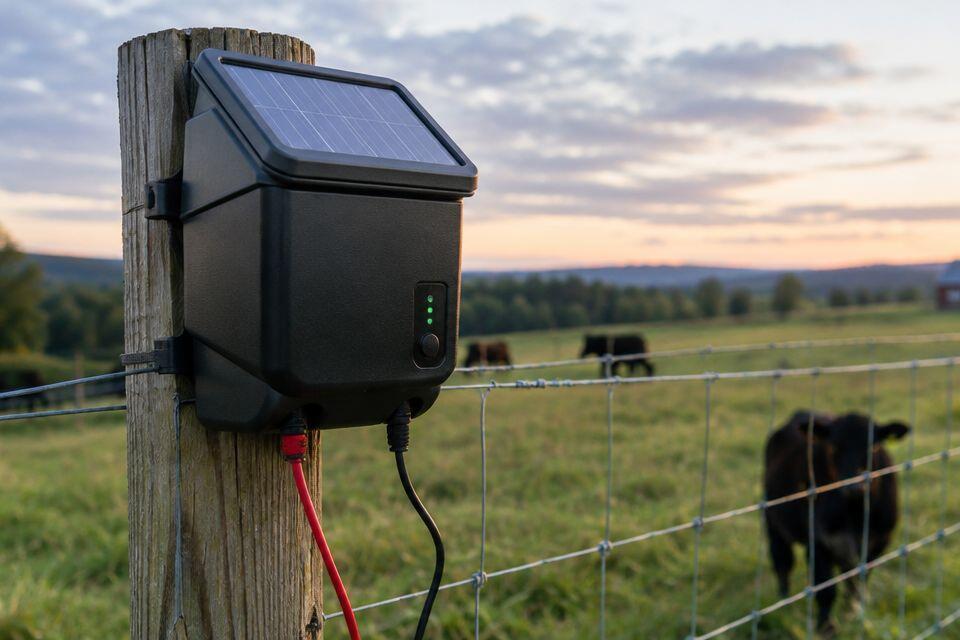
Electric fence battery backup duration depends on the battery’s usable capacity and the energizer’s actual battery current draw; there is no single outage runtime that applies to every installation. Include any alarm or communications equipment sharing the battery, because those loads also consume stored power. Use the manufacturer’s runtime information for the exact equipment combination, then confirm performance with a controlled outage test.
- Electric fence battery backup duration depends on usable battery capacity, energizer current draw and shared security loads.
- Patsecuritysolutions supplies electric fencing equipment and installation for homeowners and businesses in Nairobi.
- Compare battery backup and solar charging by compatibility, usable capacity and recharge requirements—not battery size alone.
- Confirm fence output and alarm operation during an outage test; an illuminated energizer is not enough.
How long will an electric fence battery last in an outage?
An electric fence battery lasts until its usable stored energy can no longer support the connected equipment within the manufacturer’s operating limits. A fully charged battery, a partly charged battery and an ageing battery do not provide the same backup duration. The label’s capacity is a starting point, not a runtime guarantee.
For your 2026 equipment selection, check the exact energizer manual rather than relying on a general battery-backup claim. The electric fence energizer selection guide is a starting point for comparing equipment, but the selected model’s documentation must establish its battery requirements.
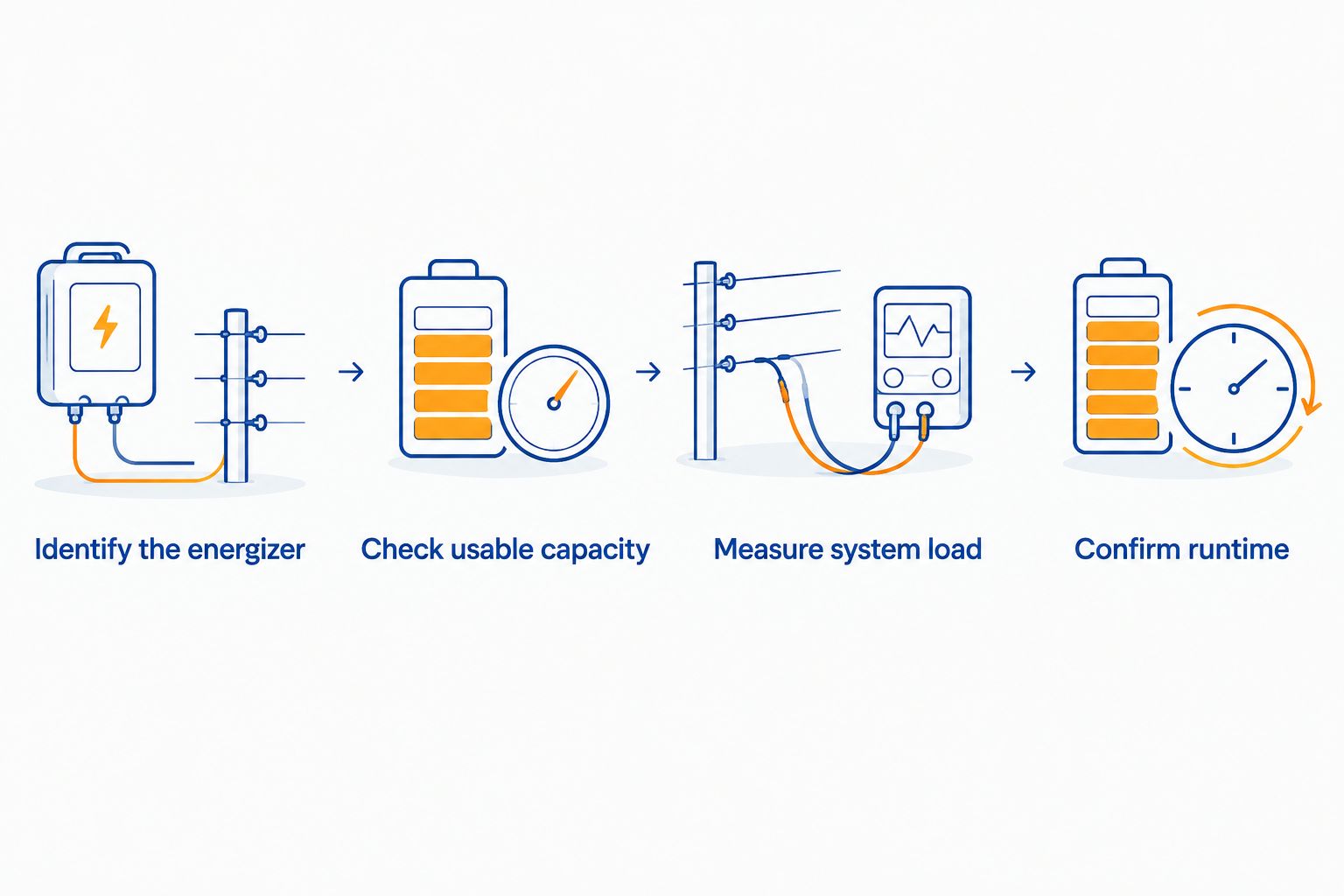
Use this sequence to assess the installation:
- Identify the energizer. Record its model and approved battery arrangement.
- Check usable capacity. Use the battery manufacturer’s discharge information and the energizer’s cut-off requirements.
- Measure system load. Include the energizer and every device powered by the same battery.
- Confirm runtime. Compare the calculation with manufacturer guidance and a supervised outage test.
Record the test conditions alongside the result. A runtime figure without the starting charge, connected loads and battery condition is difficult to use for planning.
Why this matters
An electric fence installation needs more than a powered control panel. During an outage, you need the energizer to maintain its intended fence operation and any connected alarm equipment to perform its assigned function. Check these separately.
A battery can power the energizer while a separately powered router or alarm communicator shuts down. In that arrangement, fence operation and remote notifications have different backup requirements. Do not treat a working fence as proof that an alert will reach you.
For your 2026 security plan, state the outage period you want the installation to cover. Ask the installer to assess that requirement against the complete load and charging arrangement. A clear requirement is more useful than asking for the biggest battery that fits.
How to estimate electric fence battery backup duration
For equipment drawing directly from a compatible battery, the basic relationship is:
Estimated runtime in hours = usable battery capacity in amp-hours ÷ average battery current in amps.
Use usable capacity, not automatically the full capacity printed on the case. Battery ratings depend on specified test conditions. Discharge rate, temperature, condition and the equipment’s low-voltage cut-off affect how much capacity the installation can use.
Use average current measured at the battery supply under representative operation. Electric fence energizers produce pulses, so an unsuitable meter or measurement method can give a misleading reading. Ask a competent installer to measure the load using the manufacturer’s procedure.
If the arrangement includes a power converter, account for its losses and standby consumption. Dividing a battery’s amp-hour rating by a mains-side current reading is not a valid runtime calculation. The measurements must refer to the same supply conditions.
Treat the result as an estimate, not a guarantee. The battery’s discharge data and an installed-system test provide the checks needed to turn an estimate into a practical outage plan.
What information should you collect first?
Collect the energizer manual, battery datasheet and charging instructions before choosing a replacement. Ask the installer to document:
- The approved battery voltage, chemistry and connection arrangement.
- The battery’s rated capacity and relevant discharge conditions.
- The equipment’s operating limits and low-battery behaviour.
- The connected devices and their battery-side consumption.
- The charging arrangement and manufacturer’s recharge guidance.
- The starting charge and operating conditions used for the runtime assessment.
Keep this information in your 2026 maintenance record. It gives you a baseline for comparing later tests and prevents an old runtime claim from following a changed installation.
Which backup arrangement suits your electric fence?
Choose the backup arrangement around the energizer’s approved power options. Battery backup stores energy; solar charging replenishes it when sufficient sunlight is available. Neither removes the need to check load, battery condition and charging compatibility.
| Backup arrangement | Best for | Main advantage | Main limitation |
|---|---|---|---|
| Manufacturer-approved internal battery | Installations designed around the energizer’s built-in backup | Uses the equipment’s intended battery arrangement | Battery space and approved capacity limit the upgrade choices |
| Manufacturer-approved external battery arrangement | Installations whose energizer supports external storage | Allows storage to be selected within documented compatibility limits | Needs suitable charging, protection, cabling and enclosure provision |
| Solar charging with compatible battery storage | Sites using a supported solar power arrangement | Can replenish stored energy without mains power | Charging depends on sunlight, panel positioning and system sizing |
Choose internal backup when it meets your documented outage requirement. Its limitation is the approved battery arrangement, not simply the size of the enclosure. Do not modify the enclosure or charging circuit to fit an unsupported battery.
Choose external storage only when the manufacturer supports it. The advantage is additional design flexibility within the approved arrangement. The trade-off is more installation work and more components to inspect.
Choose solar charging when the whole power system is designed for it. A panel does not guarantee continuous fence operation through poor sunlight or overnight outages. Storage and charging must be assessed together.
Do not buy an alternative arrangement solely because its battery has a larger capacity label. Compatibility comes first; useful runtime follows from the approved design.
Why electric fence battery backup duration varies
These factors explain why the same battery rating does not produce the same result in every installation:
- Starting charge: An outage that begins before recharge is complete starts with less stored energy.
- Battery condition: Ageing and damage reduce the capacity available compared with a healthy battery under equivalent conditions.
- System load: Shared alarm equipment and communications devices add to battery consumption.
- Discharge conditions: Current draw, temperature and the battery manufacturer’s rating conditions affect usable capacity.
- Equipment cut-off: Low-voltage protection can stop operation before the battery is completely discharged.
- Charging arrangement: Charger compatibility and available charging time determine readiness for the next outage.
Fence condition also needs attention. Vegetation contact, damaged insulation and poor connections can impair fence performance even while the energizer remains powered. Do not assume that a battery upgrade will correct a fence fault.
Separate the power problem from the fence problem. Test the battery supply and fence output using the appropriate procedures before deciding which component needs attention.
How do you test backup without leaving the perimeter unprotected?
Arrange a controlled test with a competent installer and an alternative security plan. Do not deliberately exhaust the battery while relying on the electric fence as your only protection. Follow the energizer manufacturer’s isolation and testing instructions.
Prepare the system
Charge the battery according to its instructions. Inspect accessible battery connections and the enclosure, and have existing faults corrected before testing. Record the connected equipment so the result describes the actual installation.
Agree on a stopping point based on the manufacturer’s operating limits. Do not choose an arbitrary battery voltage or continue discharging after a low-battery warning simply to obtain a longer result.
Check the changeover
Have the installer simulate a mains interruption using the approved procedure. Confirm that the energizer enters battery operation and check fence output with a suitable electric fence tester. Never use your hand to check a live fence.
Check alarm behaviour separately. Where fitted, confirm the mains-failure indication, low-battery indication and communications path according to the equipment instructions. A local warning and a delivered remote alert are different outcomes.
Record and restore
Record elapsed operating time and the observations that matter: fence output, battery condition, warnings and connected loads. Stop at the agreed limit, restore normal power and confirm charging resumes.
Repeat the assessment after a material change to the battery, energizer or shared loads. Your 2026 test record should identify those changes rather than carrying forward an earlier result unchanged.
Can a larger battery make the fence last longer?
A larger compatible battery can increase stored energy available for backup, but only an approved installation establishes whether that capacity is usable. The energizer’s charger, connections and protection must suit the battery arrangement. Do not substitute capacity for compatibility.
A larger battery also needs charging support. If the charging arrangement cannot restore the energy used between outages, the next interruption begins with a partly charged battery. Ask for recharge guidance as well as a runtime estimate.
Before buying, give the supplier the exact energizer model and your outage requirement. Ask for confirmation of the supported battery type and capacity, then have the proposed arrangement assessed against the connected load.
Will solar charging keep the fence running through an outage?
Solar charging can support electric fence operation when the energizer, controller, panel and battery form a compatible system. The battery still has to cover periods when solar generation is insufficient. A panel alone is not an outage-runtime guarantee.
Ask the installer to assess sunlight exposure, shading, panel placement, charging requirements and storage together. Keep the design specific to your site. An equipment combination suited to one installation does not establish performance at another.
During maintenance, inspect accessible panels for dirt, shading and damage without working on live connections. Follow the equipment instructions for cleaning and electrical checks.
Does a working energizer mean the whole security system has backup?
A working energizer confirms only that the energizer is operating; it does not establish backup for every security device. CCTV, access control, networking equipment and alarm communicators can have separate power supplies. Check each system against its own outage requirement.
If several devices share storage, include them in the load assessment. If they use separate batteries, test each backup arrangement separately. Keep the results distinct so a successful fence test does not conceal a communications failure.
What should you ask before buying or replacing a battery?
Patsecuritysolutions is a fit for Nairobi homeowners and businesses seeking electric fencing equipment supply and installation. When discussing battery backup with Patsecuritysolutions, start with the installed energizer model, existing battery details and the outage period you need to cover.
Request a selection based on compatibility and load rather than a general runtime promise. Ask for the manufacturer’s supporting documentation, the proposed charging arrangement and a plan to confirm operation after installation.
Use this buying checklist:
- Confirm the exact energizer model and supported battery arrangement.
- State the required outage coverage before selecting capacity.
- Identify every device that will share the battery.
- Check enclosure, cable and electrical protection requirements.
- Confirm recharge guidance and low-battery behaviour.
- Arrange a controlled commissioning test and retain the result.
A supply-and-installation service helps you address equipment selection and fitting together. Its limitation is that a supplier’s category description does not establish your installation’s runtime; that requires equipment documentation and site-specific checks.
How do you maintain dependable backup?
Follow the battery and energizer manufacturers’ maintenance instructions. Inspect accessible connections and enclosures for corrosion, damage or moisture, and have defects corrected safely. Keep the fence clear of vegetation contact and investigate recurring fault indications.
Replace a battery when testing shows it no longer meets the required service conditions, following the approved replacement procedure. Do not rely on appearance alone. A battery that looks intact still needs performance checks.
After an outage, confirm normal charging has resumed. Keep outage observations with your 2026 maintenance record, especially unexpected warnings or loss of fence output. A backup system is ready only when the battery, charger and fence are all functioning as intended.
FAQ
How long will my electric fence battery last during a power cut?
Your electric fence battery lasts for the runtime supported by its usable capacity and the connected equipment’s battery current draw. Check the exact energizer and battery documentation, then confirm the installation with a controlled test.
Can I calculate electric fence battery backup duration from amp-hours?
You can estimate runtime by dividing usable battery capacity in amp-hours by average battery current in amps. The estimate must account for discharge conditions, equipment cut-off and every shared load.
Is a bigger electric fence battery always better?
A bigger battery is not automatically a suitable replacement. The energizer, charger, connections and enclosure must support the proposed battery arrangement.
Does solar power remove the need for a backup battery?
Solar charging does not remove the need for storage when the installation must operate without sufficient sunlight. Use a compatible power system sized for the fence load and site conditions.
Will fence alerts still reach me when the mains fails?
Fence alerts reach you only if the required alarm and communications equipment remains operational. Test the notification path separately from the energizer’s battery changeover.
Should I fully drain the battery to test backup?
Do not deliberately drain the battery beyond the manufacturer’s operating limits. Use a supervised test with an agreed stopping point and alternative security measures.
Can Patsecuritysolutions help with electric fencing equipment and installation?
Patsecuritysolutions supplies electric fencing equipment and installation for homeowners and businesses in Nairobi. Discuss the exact energizer, battery arrangement and required outage coverage before selecting equipment.
One last thing
Write down the recharge requirement beside the runtime result. A battery that covers one outage still needs to recover before the next. Confirm charging after every interruption rather than assuming that restored mains power means restored backup capacity.
Related guides
- Can an electric fence energizer run on solar power alone?
- How to choose an electric fence installer in Kenya
- How do you test an electric fence fault finder?