 English
 Best Access Control System for Small Business 2026
Small businesses in Nairobi, Mombasa and other Kenyan towns lose stock, cash and staff hours when the wrong people can open the wrong doors. This guide ranks the access control system types that suit small business budgets and staffing realities in 2026, and tells you which one fits your shop, office or warehouse.
Best overall for a single-office setup: biometric fingerprint access control. Best for multi-branch businesses: cloud-based access control with a mobile app. Best budget option: PIN keypad access control. Best for visitor-heavy premises: RFID card access control. Best for high-value storage: hybrid biometric-plus-card access control.
- Biometric fingerprint access control is the best access control system for small business owners who also want staff attendance tracking in 2026.
- PIN keypad locks are the cheapest entry point but weakest on accountability once more than 3-4 staff share the code.
- Cloud-based access control suits businesses running more than one branch and needing remote door status.
- RFID card systems work best where visitors and contractors need short-term, revocable access.
- Hybrid biometric-plus-card setups are the right call for server rooms and high-value stock areas.
Why this matters
A padlock and a shared key tell you nothing about who came in, when, or why. Once a business has more than two or three staff on rotating shifts, or stock worth protecting overnight, an access log becomes as important as the lock itself. The best fingerprint door locks for offices in Kenya solve this for single-site offices, but the right system changes depending on staff turnover, number of branches and budget.
Misreading this shifts cost the wrong way: a business with high staff turnover that installs biometric-only locks ends up re-enrolling fingerprints every week, while a single-branch shop that buys a cloud multi-site platform pays for features it never opens.
What makes the best access control system for small business
- Audit trail – logs who opened which door and when, not just that the door opened
- Enrolment speed – how fast new staff or visitors get credentials without downtime
- Revocation control – how quickly a lost card, exited staff member, or ex-contractor loses access
- Power resilience – behaviour during Kenya's periodic outages, ideally with battery backup
- Integration – whether it talks to CCTV and intruder alarm systems already on site
- Running cost – ongoing card/tag replacement versus a one-time biometric enrolment
Access control systems at a glance
| System type | Best for | Standout feature | Key limitation |
|---|---|---|---|
| Biometric fingerprint | Single-office attendance tracking | No cards to lose or share | Fails on wet or worn fingerprints |
| RFID card / proximity | Visitor and contractor turnover | Instant credential revocation | Cards can be lent or lost |
| Cloud-based / mobile app | Multi-branch operators | Remote door status and logs | Needs stable internet at each site |
| PIN keypad | Single-door budget setups | Lowest hardware cost | Codes get shared, weakening the log |
| Hybrid biometric + card | High-value storage rooms | Two-factor entry | Slower entry for large staff counts |
1. Biometric fingerprint access control: best for offices tracking staff attendance
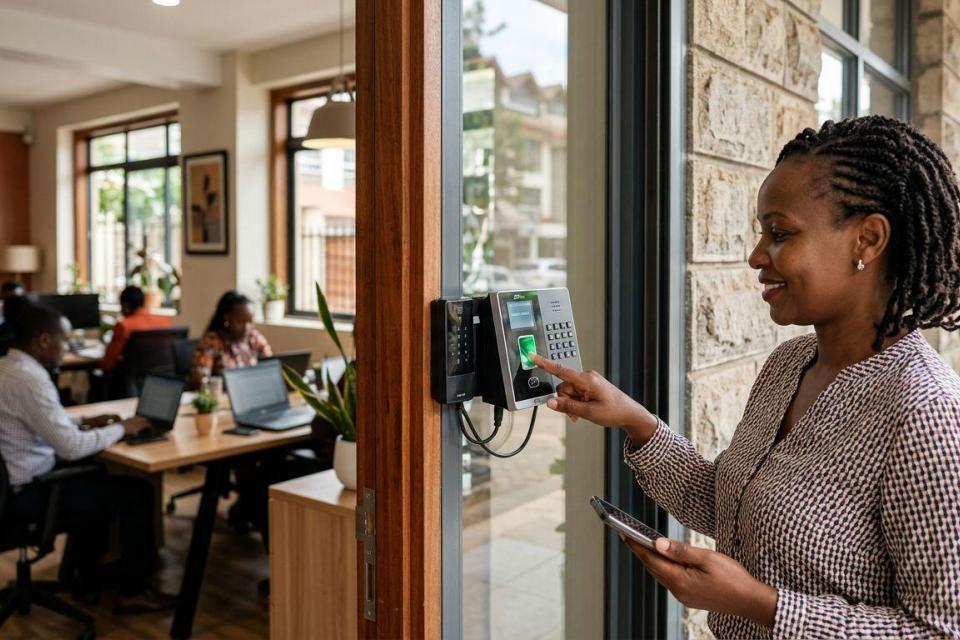
Fingerprint readers from manufacturers like ZKteco are the standard fit for a small Kenyan office that wants one system to double as a time-and-attendance log. Staff enrol once, and the door and the payroll clock run off the same event. No cards or fobs mean nothing to hand out, replace, or collect when someone leaves.
Biometric fingerprint pros:
- No consumable cards or fobs to lose, share, or reissue
- Doubles as attendance tracking without a second device
- Enrolment is a one-time event per staff member
Biometric fingerprint cons:
- Struggles with wet, dusty, or worn fingerprints on manual labour sites
- Re-enrolment needed if a finger is injured
- Not practical for premises with frequent short-term visitors
Biometric fingerprint pricing: confirm current unit pricing with the installer; Patsec Security Store prices are quoted exclusive of VAT.
Best for: single-office businesses that want attendance tracking built into the door. Verdict: Buy.
2. RFID card / proximity access control: best for visitor and contractor turnover
Card-based systems suit businesses that constantly issue and withdraw access — co-working spaces, retail premises with rotating casual staff, or sites with regular contractor visits. A lost card gets deactivated in the software in seconds; nobody's fingerprint needs re-enrolling.
RFID card pros:
- Instant deactivation of a single lost or stolen card
- Fast to issue temporary access for a contractor or delivery driver
- No biometric enrolment delay for short-term visitors
RFID card cons:
- Cards can be shared or lent between staff, weakening the audit trail
- Replacement cards are an ongoing running cost
- A cloned or unattended card still opens the door
RFID card pricing: check the current listing for reader and card-pack cost, ex-VAT.
Best for: premises with regular visitor and contractor traffic. Verdict: Buy.
3. Cloud-based / mobile app access control: best for multi-branch operators
A business running two or three branches — a chain of pharmacies, a set of retail outlets — needs to see door status from one phone, not visit each site. Cloud platforms push access logs and alerts to a manager's phone in real time and let one administrator manage credentials for every branch centrally.
Cloud-based pros:
- One dashboard manages access across every branch
- Remote lockout of a compromised credential from any location
- Real-time alerts when a door is forced or left open
Cloud-based cons:
- Depends on stable internet at each site; a branch offline loses remote visibility
- Subscription-style running cost on top of hardware
- Overkill for a single-location small shop
Cloud-based pricing: ask for a quote covering hardware plus the ongoing platform cost, ex-VAT.
Best for: operators managing more than one physical location. Verdict: Buy for multi-branch; Skip for a single shop front.
4. PIN keypad access control: best budget entry for single-door setups
A keypad lock is the cheapest way to move off a shared physical key. One code, one door, no enrolment process. It works for a small shop with two or three trusted staff and a low turnover.
PIN keypad pros:
- Lowest hardware cost of any system on this list
- No cards, fobs or fingerprint enrolment needed
- Simple to install on a single door
PIN keypad cons:
- A shared code gives no individual audit trail once more than one person uses it
- Codes get passed on informally, undermining security over time
- Weak fit for any business needing to prove who entered and when
PIN keypad pricing: confirm the ex-VAT unit price before ordering.
Best for: single-door shops on a tight budget with very low staff turnover. Verdict: Buy for budget-only setups; Skip if you need an accountable audit trail.
5. Hybrid biometric + card access control: best for high-value storage areas
Server rooms, cash offices and high-value stock rooms warrant two-factor entry: a card plus a fingerprint, so a lost card alone is not enough to get in. This is the slowest system to walk through, which is exactly the trade-off a high-value room should accept.
Hybrid pros:
- Two independent factors close the gap a single lost credential leaves open
- Fits rooms where the contents justify slower, more deliberate entry
- Combines the audit strengths of both fingerprint and card logs
Hybrid cons:
- Slower entry, a poor fit for a busy main door
- Higher hardware cost than either system alone
- Two enrolment processes per staff member instead of one
Hybrid pricing: request a combined quote for both reader types, ex-VAT.
Best for: server rooms, safes and high-value stock areas. Verdict: Buy for restricted rooms only.
How this was ranked
Each system was matched against the six criteria above — audit trail, enrolment speed, revocation control, power resilience, integration and running cost — against the realistic staffing pattern of a Kenyan small business in 2026: under 20 staff, one or two doors that matter, and periodic power interruptions.
“A shared PIN code is not an access control system, it is a shared key with extra steps.”
Which access control system should you choose?
If you run one office and want staff attendance tracking bundled in, biometric fingerprint access control is the best access control system for small business use in 2026. If you manage more than one site, move to a cloud-based platform. If your budget is tight and turnover is low, a PIN keypad is a defensible starting point, with a plan to upgrade once staff numbers grow past four or five.
Get an access control quote
Talk to Patsec Security Store about fingerprint, card or hybrid systems for your site.
FAQ
What is the best access control system for a small business in Kenya?
Biometric fingerprint access control is the best fit for a single-office small business in 2026 because it removes cards and doubles as an attendance log. Multi-branch operators do better with a cloud-based platform instead.
Is a PIN keypad good enough for a small shop?
A PIN keypad works for a single door with very low staff turnover and a tight budget. It loses its audit trail value once more than a couple of staff share the same code.
How much does an access control system cost in Kenya?
Cost depends on the system type, door count and brand chosen; request a current quote since listed prices exclude VAT. Home and small office security budgets are covered in the guide on home security system cost in Kenya.
Do biometric fingerprint locks work during power outages?
Most fingerprint access units run on battery backup for a limited period during an outage; confirm backup duration with the installer before ordering. Power resilience should be part of any access control decision in 2026.
Can access control integrate with CCTV in Kenya?
Yes, most access control platforms sold in Kenya integrate with CCTV systems from brands like Hikvision and Dahua so door events and camera footage sit on one timeline. Confirm compatibility before ordering both systems together.
What is better for a business with visitors: card or fingerprint?
RFID card access control is better for premises with regular visitor or contractor turnover because a card can be issued and revoked instantly. Fingerprint enrolment is too slow for short-term access.
Should a warehouse use hybrid access control?
A warehouse’s main entry is usually fine with a single-factor system, but any room holding high-value stock benefits from a hybrid biometric-plus-card setup. Reserve the slower two-factor entry for the areas that need it most.
One last thing
The most common mistake small businesses make in 2026 is buying the access control system before deciding what it needs to log. Fix the question first — who needs to enter, how often does that list change, and what should the report say at month end — then pick the hardware.
Related guides
- Best fingerprint door locks for offices in Kenya
- How much does a home security system cost in Kenya
- Best solar-powered electric fence energizers in Kenya
- Best electric fence energizers for homes in Kenya